Friday, March 31, 2006

Why 'The Gurls' Hate On Each Other


One of my TSTB members posted to the list last week a comment about how surprised and shocked she was to see how some African-American transwomen treat each other.
It's nothing new. The way some of 'The Gurls' negatively interact with one another is a long-term observation of mine that has exasperated me over the two decades I've been around the African-American transgender community.

WARNING: What follows are my personal observations. If they hit too
close to home, nothing personal. To borrow the words of the late DJ
icon Jack 'The Rapper' Gibson, I'm tellin' it like it 'TIS' is.

We're basically split into six factions. The Street Girls, the Stealth
Girls, The Club Girls, The Pageant/Show Girls, The Crossdressing
Girls, and the Real World Girls.

Some of the Street Girls either HATE on everybody that's in the other
four groups or harbor deep suspicions about their transsistahs.
They've had hard lives and resent the fact that in their eyes,
the 'rest of us have it easy' or 'we look down our noses at them'.
They feel like everything should be handed to them on a silver
platter since they've had to struggle for everything they get.

The Stealth Girls blitzkrieg through the transition process, get
their surgery, and then disappear never to be seen again in the
transgender community. They are women now and they believe that they
are better than pre-ops because they don't have that pesky male organ
between their legs. Some of them cut off all contact with out
transgender people and won't be caught dead at a drag show or GLBT
club. They don't want even a hint of suspicion from the people that
are in their new lives that they're transgendered.

The Club Girls lives revolve around the various GLBT clubs sprinkled
across the nation. Some are well into their transitions while others are crossdressing until they can get to that point. They hang out trying to pick
up `husbands' to validate their new gender identity or `trade' to
make a fast buck. They are hostile to any other t-girl that comes
into their turf that's prettier, smarter, younger, more popular or `fishy'
looking than they are.

The Pageant/Show Girls lives revolve around the various transgender beauty pageant circuits that are held across the nation and the drag shows in various GLBT clubs. They are a fairly tight knit sorority. Some of them have interests outside that world, others don't.

The Crossdressing Girls are the ones that are either in the early
stages of discovering whether they are transgendered or just dress in
women's clothes for the fun of it. There's some friction between
them and the t-girls because they remind the t-girls too much of
where they came from and wish to forget. The Crossdressing girls
sometimes forget that t-girls AREN'T guys on `mones, we are emotionally women. When they treat t-girls as one of the fellas they resent it. T-girls have pissed off crossdressers by making snide comments about their ability to pass as women, which is a sensitive subject with them.

The Real World Girls are the ones who are so far out of the closet it would take a bulldozer to shove them back into it. They're the activists and the peeps who are out and about in the community. They annoy the other groups on various levels. The street and club girls consider them uppity and elitist. The stealth girls wish they would quit 'rocking the boat' with their activism so that they can continue hiding and living their lives as women. The pageant girls are indifferent about it and the crossdressers have split loyalties on the subject.

Is it any wonder why we've had such a hard time building a cohesive
community with all this Hateraid between the various groups?

The bottom line is that our enemies hate all of us no matter what faction we belong to. We are all potential victims of hate crimes because of who we are. If everybody would take a deep breath and realize that we all have something substantive to bring to the table as we build a community, there's no telling what we could accomplish pulling together.

Black America's Infatuation With Butch Men Up in Heels


By Jasmyne Cannick
February 24, 2006


While images of Black men dressed as woman have become a popular part of Black American culture in entertainment, does the success of the Black actor who plays a role in drag depend on that actor's heterosexism in real life?

True story.

I was in a theatre in a predominately Black part of town and there was a poster for Madea's Family Reunion up in the lobby of the theatre. Several Black women who looked to be in their 40s and 50s had gathered around the poster and were remarking how they were going to see the film when it came out. Just then a Black transgendered female walked through the lobby and one of the women remarked to her girlfriends, "Look girl, a he-she," and they all started giggling like teenagers.

On more than one occasion Black America has rushed to the box office to see Black men dressed in drag and with the national release of Tyler Perry's Madea's Family Reunion, Black audiences will again embrace the idea of a man playing a female role on screen.

On more than one occasion Black America has rushed to the box office to see Black men dressed in drag and with the national release of Tyler Perry's Madea's Family Reunion, Black audiences will again embrace the idea of a man playing a female role on screen.

When Tyler Perry debuted his character Madea Simmons, a 68 year-old witty gun toting grandmother from the hood, his biggest audience was Black Christian evangelicals. In fact, it was Black Christians that launched him to where he is today, packing in and filling up theatre after theatre as he toured around the nation with his plays. With a spiritual message included in all of his productions, Perry allowed Black Christians to feel good after seeing him prance around the stage dressed as woman.

But before Madea, there was Andre Charles, better known as RuPaul. In the early 90's, RuPaul gained fame and success with his single "Supermodel (You Better Work)" a tribute to the divas of the fashion. The single placed in the top 30 on the Billboard Pop Charts and the music video was nominated for Best Dance Video at the 1994 MTV video music awards. Through the years, RuPaul has appeared in various movies and music specials. He was honored as in 1999 with the Vito Russo Entertainer of the Year Award at The Gay & Lesbian Alliance Against Defamation (GLAAD) media awards for challenging the limits and breaking boundaries in becoming an openly gay individual who has achieved excellence in the field of entertainment and furthering his visibility and understanding of the community through his work. Still, RuPaul's fame and acceptance has come from mostly white audiences, even though he is a Black entertainer.

So why is it that Black audiences can embrace a man playing a female role on the silver screen, but still have problems with real life Madea's in their own communities and families?

Transgender is an umbrella term used to describe people whose gender identity, expression or behavior is different from those typically associated with their assigned sex at birth, including but not limited to transsexuals and cross dressers.

In the Black community, very little attention is focused on the transgender community. Common practice is to group transgenders with gay men, even though they are their own community within an already marginalized group.

Even in the gay rights movement, transgender issues have been pushed to the bottom of the list for fear that Americans, who are barely able to deal with the idea of marriage between gay and lesbian couples, could even begin to understand the issues plaguing the transgender community.

Madea is a man dressed as a female, plain and simple. No matter how many feel good religious messages Tyler Perry feeds his audiences, Black Christians are embracing cross dressing as a form of entertainment, which is not problematic, except for the fact that Black Christians are known for their homophobic views towards anything remotely gay.

But what if Tyler Perry were gay? Would Madea continue to be as popular among Black churchgoers? Probably not. At least with his assumed heterosexuality, Christians can rest at ease that they are not supporting anything gay because after all, it is just a role. RuPaul, while a great performer, was openly gay and therefore never found the wide spread acceptance and fame that Madea has. Famed actor Wesley Snipes gave us Noxeema Jackson in the 1995 film To Wong Foo Thanks For Everything, Julie Newmar. While heterosexual himself, Snipes' character was flamboyantly gay. Martin Lawrence first introduced us to Big Momma in 2000 and was so successful that's he's back with a sequel. He too is heterosexual. And who could forget "Men on Film" on In Living Color, featuring Damon Wayans and David Allen Grier who played the very gay film critics Blaine Edwards and Antoine Merriweather. Again, both Wayans and Grier are heterosexual and went on to do great things after the end of the series.

Blacks have no problem with cross dressing and transgenderism as a form of entertainment. It's only after the lights go off and the camera stops rolling that it becomes an issue if the dress and heels are still on.

Sunday, March 26, 2006

Life after Gwen


An Op-Ed piece that appeared in the San Francisco Chronicle
----------------------------------------------------------------
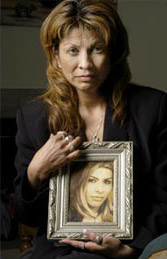
Sylvia Guerrero
Thursday, January 26, 2006


I am not sure how I expected to feel at this point. When my daughter Gwen, a transgender teenager, was brutally murdered on Oct. 4, 2002, I was sure that I would never feel whole again. Looking back, I didn't yet know exactly what "transgender" meant or how to fully embrace my child's identity. But I knew one thing: I wanted justice for my child.

I thought that maybe I'd feel better on the day when the four suspects in her murder were brought to justice. More than three years and three months since Gwen's murder that day is finally here. On Friday, these men are being sentenced to prison terms for their actions, two of them convicted of second-degree murder and two taking plea bargains for voluntary manslaughter. I guess I hoped that once we got to the sentencing date, the pain would end and I could get back to my life. But it hasn't and I can't.

No amount of justice can return the part of me that these men took when they killed Gwen. The closure that people keep talking about hasn't come. It would be so much easier to write that it had. After all, that is what most people want to read: The system worked; my family is whole; the story is over. It would be comforting and allow us to get on with our lives. Of the many things I'm feeling, closure isn't one of them.

I'm angry. Angry that Gwen's brothers and her nieces and nephews won't get to grow up knowing her the way her aunts, uncles, older sister and I did. Angry that instead of celebrating her birthday, we get together each year to commemorate her death. Angry that, in both trials, the defendants tried to blame Gwen for her own murder. Angry that other young lesbian, gay, bisexual or transgender kids continue to face the discrimination she did in our public schools and our workforce.

I'm also grateful. Grateful that my family and our friends rose to the challenge and sat through two gruesome and explicit criminal trials to make sure that everyone knew that Gwen was loved for who she was. I'm grateful for the support we've all received from perfect strangers who have told us in-person and through e-mail that we are in their thoughts and prayers. I'm grateful for the remorse that two of the defendants and some of their family members have expressed to me and my family.

And I'm sad. Sad that I'll never get to see Gwen grow into the beautiful woman she would have become. Sad that four men chose to end my daughter's life, and throw away their own simply because they thought they were acting like "real men." And sad that other transgender women have been killed since Gwen's murder and that we don't have a realistic end in sight to that violence.

Within this mix of emotions, though, the one that I hold onto most dearly is hope. Since that tragic night, my own family has grown by two beautiful grandchildren. More and more parents are supporting their transgender children. California has become the country's most protective state for transgender people. And just this month, a new law has been proposed in Sacramento, the Gwen Araujo Justice for Victims Act, authored by Assemblywoman Sally Lieber, D-Mountain View, and sponsored by Equality California, an LGBT civil-rights lobbying group, to protect people from being blamed for their own murder.

Maybe the reason I don't have closure around Gwen's death is that there is still work to do. If I've learned anything since Gwen's murder, it is that hope alone is not enough. Each of us who hopes to live in a state where our families are protected needs to work toward making California that place. For instance, boys and girls in schools throughout the Bay Area need to hear, firsthand, how important it is to be themselves and to respect each other's differences.

None of us can change the way the world was on Oct. 4, 2002. But each of us now has an important role to play in creating a state where we can celebrate more birthdays and commemorate fewer murders.

Sylvia Guerrero is the mother of Gwen Araujo and an activist for LGBT civil rights. She speaks at schools around the Bay Area through the Gwen Araujo Transgender Education Fund administered by the Horizons Foundation.