Tuesday, February 28, 2006

There Were Balls In Chicago, Too


Many of you have probably seen the 1990 Jennie Livingston 'Paris Is Burning' documentary which chronicles a slice of the Harlem drag ball scene.
What many people don't realize is that the balls weren't just a Harlem thang.
Chicago had a drag ball scene also.

There have always been balls in Chitown, but they were limited to New
Year's and Halloween: the few times of the year a man could dress in
women's clothes and not be arrested.

Chicago's ball tradition can be traced back to the late 1800's.
The aldermen team of "Bathhouse" John Coughlin and Michael "Hinky
Dink" Kenna (known as the "Lords of the Levee District"), threw
the 'First Ward Balls' at the Chicago Coliseum as a was of extracting
money from the brothel owners in the levee district.

Bathhouse John would lead a Grand March procession consisting of
prostitutes, drag queens, pickpockets, pimps, madams and other
colorful characters. The evening almost always ended in some type of
riot. These were held annually through the turn of the century until
they were finally stopped by the mayor of Chicago in 1909.

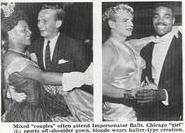
When African-Americans began the Great Migration out of the rural South, they flocked to northern urban centers such as New York, Detroit and Chicago. GLBT African Americans gravitated to Chicago's South Side, frequenting clubs like the Pleasure Inn and the Plantation Café and hosting drag balls that became fashionable social events for straights and gays alike.

Enter Alfred Finnie, a gay Black man who founded what would become the biggest and best known of the Chicago balls. It started in 1935 and cost 25 cents to get in. Finnie's first ball was held in the basement of a Chicago nightclub on the corner of 38th and Michigan Avenue to a predominately African-American crowd.

From that humble beginning, Finnie's ball grew to be a huge glamorous Halloween event eagerly anticipated by denizens of the South Side. At their peak up to 1000 people, both gay and straight attended the balls.

Unfortunately Alfred Finnie was killed during a 1943 gambling brawl, but the ball he founded lived on into the 60's. The tradition of Chicago drag balls was carried into the 70's and beyond by the late Chicago drag legend Jacques Cristion and Dodi Danials.

Cathay Willams-TG Buffalo Soldier


Cathay Williams has the distinction of being the only female member of the legendary Buffalo Soldiers. How did she do so in a time when the Army did not allow women to enter their ranks? Read on.

Cathay Williams was born into slavery in 1842 in Independence, MO.
She worked as a house slave for a wealthy Jefferson City, MO planter
named William Johnson until his death, which happened to coincide
with the outbreak of the Civil War in 1861.

After being freed by Union soldiers Cathay began working for the Union Army as a paid servant. She grew to like the discipline and regimentation of military life as she traveled with the Union Army throughout the war. Cathay's travels took her to New Orleans, Savannah GA, Macon GA and other locales.

Because she was so responsible and dependable, she was recruited to go to Washington DC to work as a cook and laundress for General Phil Sheridan and his staff. She accompanied Gen. Sheridan when he made his Shenandoah Valley raids. From Virginia, Cathay journeyed to Iowa and later to St. Louis. She witnessed battles in Arkansas and Louisiana. She watched as Union soldiers destroyed cotton and burned a captured Confederate gunboat on the Red River at Shreveport. All this exposure to military activity gave her an understanding and a comfort zone about military life that proved to be invaluable in the next phase of her life as a free person.

On July 28 1866, Congress enacted legislation authorizing six all-Black units within the military. Two of the units were the famed 9th and 10th Cavalry. The other four were infantry units initially named the 38th, 39th, 40th and the 41st Infantry. In 1869 the four Black infantry units were reorganized and consolidated into two units, the 24th and the 25th Infantry. These remaining Army units became collectively known as the 'Buffalo Soldiers' after the moniker was bestowed upon them by the Plains Indians because of their fighting ability and short curly hair.

On November 15, 1866, shortly after her job with the army ended, Cathay Williams disguised her gender and joined the 38th Infantry, Company A, in St. Louis as Pvt. William Cathay. The Army didn't require physical examinations at the time and she possessed a big boned 5'7" frame. Only her cousin and a friend who had also enrolled in the unit were aware of her true identity. She contracted smallpox not long after her enlistment and as soon as she recovered joined the rest of her unit on the long march west from St. Louis via Kansas to New Mexico.

She and the rest of A Company arrived at Fort Cummings, NM on October 1. 1867 with orders to protect wagon trains travelling along the Santa Fe Trail from Apache attack. Cathay became ill in 1868 and it was at that time the post doctor finally discovered her true gender. She was discharged from the Army on October 14, 1868 and moved on to Pueblo, CO.

Years later, when a reporter asked her why she joined the army, Cathay stated, "I wanted to make my own living and not be dependent on relations or friends."

Her pension claim was denied in February 1892 and she lived out her final days ironically in a town that would later become renowed for the SRS surgeries performed there, Trinidad, CO.

Monday, February 20, 2006

State of the Black Union 2006-Houston


Seems like everything is happening in my hometown since I moved in 2001. The Super Bowl, yesterday's NBA All-Star game, an NCAA Regional basketball final in 2008 and the Final Four in 2011, the Major League Baseball All-Star Game, the World Series and an NAACP convention. Shoot, even my old high school won the state 4A title in basketball.

On February 25 Tavis Smiley brings his seventh annual State of the Black Union Conference to St. Agnes Church, a megachurch less than two miles from the neighborhood where I grew up. Arrrgh!

It will be broadcast on C-SPAN live and will unveil the Covenant With Black America along with the comments and thoughts of 35 leaders of the African-American community.

A Message from Tavis...

At the close of the 2005 State of the Black Union in Atlanta, we
invited the public to weigh in on the most challenging issues facing
Black America. I'm happy to report that because of the huge response,
we now have a document that outlines how individuals, groups,
communities and the body politic can move forward to make this nation
better. When we make Black America better, we make all of America
better. We all want an America as good as its promise.

The Covenant book is made up of 10 chapters on the issues identified by
the public. They include economic disparity, health, education and
environmental justice. While the completion of the book marks the end
of one journey, it is in many ways the first step for those who want to
move forward toward real progress in improving Black communities.


I took the opportunity to log on to BlackAmericaweb.com and submit a question for Saturday's forum that reads like this:

I am a college educated African-American who happens to be
transgendered and a Christian. I have been deeply troubled by not only
the increasing willingness of megachurch ministers to align themselves
with political forces hostile to our community, but the homophobic
remarks being uttered from their pulpits.

My question is this: does your definition of African-American community
include people like myself and what steps will be taken to ensure that
we GLBT African-Americans are part of the building process for our
community?


Be interesting to see if my question gets read this Saturday.